
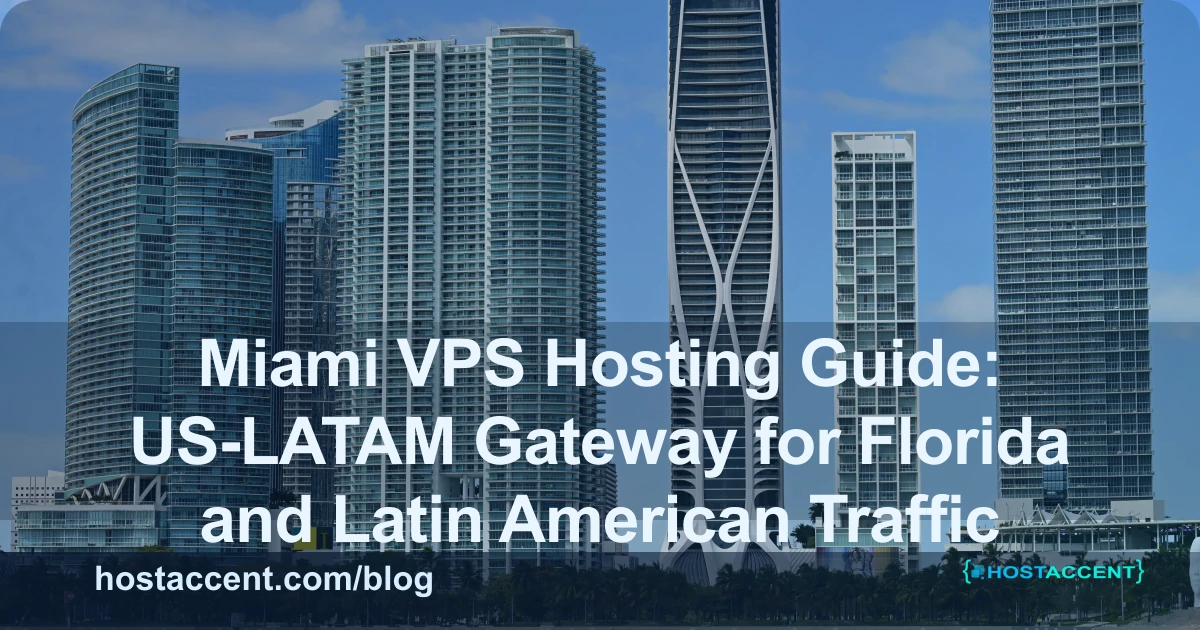
Ask most developers where to host for Latin America and they'll say "São Paulo" or "New York." Both are wrong if half your users are actually in Florida, Colombia, or Mexico. So before you buy Miami VPS capacity, map where your Florida and Latin-American users actually are.
Miami is where the submarine cables connecting North and South America come ashore. NAP of the Americas — one of the most interconnected carrier hotels in the western hemisphere — sits here. That means a Miami server reaches Bogotá in ~70ms and São Paulo in ~100ms, while a New York server takes 50–80ms more for the same trips. For any business operating in the US-LATAM corridor, that difference is the kind of thing that shows up in your checkout completion rate.
Miami's network position: the LATAM gateway
Multiple major submarine cable systems connecting North and South America terminate in or near Miami. These cables carry traffic between the US, Mexico, Central America, the Caribbean, Colombia, Brazil, and beyond. Miami-based servers sit at the convergence of these cable systems, giving them direct, low-latency paths to Latin American internet infrastructure that no inland US city can match.
Round-trip times from Miami:
- Florida (local): 1–10ms
- Atlanta: 30–40ms
- Washington DC: 35–45ms
- New York: 40–50ms
- Chicago: 45–55ms
- Dallas: 35–45ms
- São Paulo, Brazil: 90–120ms
- Bogotá, Colombia: 60–90ms
- Mexico City: 70–100ms
- Caracas, Venezuela: 50–70ms
- Lima, Peru: 80–110ms
- Buenos Aires: 110–140ms
- Santo Domingo: 30–50ms
- San Juan, Puerto Rico: 35–50ms
For a US-headquartered business with significant Latin American operations, Miami offers the best combination of US market access and LATAM connectivity available at a single datacenter location.
Who should choose Miami VPS
Businesses serving Florida and the Southeast. Florida has a population of over 22 million — larger than many EU countries. Miami, Orlando, Tampa, and Jacksonville are major metro areas with significant ecommerce, healthcare, and technology industries. For businesses where Florida represents a substantial share of US revenue, Miami hosting gives local-feeling latency for the state's users.
LATAM-facing US businesses. Companies selling into Mexico, Colombia, Brazil, Argentina, Chile, or the Caribbean from a US base find Miami's LATAM routing superior to any alternative US location. This applies to SaaS platforms, ecommerce exporters, media companies, and any business with a US-plus-LATAM audience.
Latin American businesses with US operations. Brazilian, Mexican, Colombian, and Argentine companies establishing US market presence often choose Miami as their US datacenter location. The cultural connection (Miami is bilingual, with large Spanish and Portuguese-speaking communities), combined with the submarine cable advantage, makes Miami the natural US base for LATAM-headquartered businesses.
Spanish and Portuguese-language digital platforms. Content platforms, news sites, streaming services, and SaaS products serving Spanish-speaking or Portuguese-speaking users across multiple countries in the Americas benefit from Miami's position. A single Miami origin can reach both US Hispanic users and LATAM users reasonably well.
Financial services with Caribbean and LATAM exposure. Miami is a significant financial hub for Latin American capital flows, wealth management, and trade finance. Fintech companies, payment processors, and banking technology serving LATAM clients through Miami-based operations have natural reasons to keep their infrastructure aligned with their operational geography.
Healthcare and medical tourism. Miami is a significant medical tourism destination, particularly for patients from Latin America. Healthcare platforms, patient communication systems, and medical records infrastructure serving both Florida providers and international patients find Miami hosting practical.
Miami's carrier infrastructure
NAP of the Americas brings together dozens of network providers at a single interconnection point in Miami. Major carriers with Miami presence include AT&T, Comcast, Lumen (Level 3), Telia, and Cogent. This carrier diversity means Miami-origin traffic has multiple routing options to reach both domestic US destinations and Latin American networks — improving both latency and resilience.
Miami is also increasingly connected to US Federal infrastructure — US Customs and Border Protection, FEMA, and other federal agencies with Caribbean and LATAM operations have technical infrastructure near Miami.
Production setup for Miami/LATAM workloads
Locale and time zone considerations:
- Florida is Eastern Time:
America/New_York - If serving LATAM users, handle time zones per country in application logic — Mexico City is
America/Mexico_City(CST/CDT), São Paulo isAmerica/Sao_Paulo(BRT, no DST), Bogotá isAmerica/Bogota(COT, UTC-5 fixed) - Character encoding:
utf8mb4with proper collation — essential if serving Spanish (ñ, ¿, ¡) and Portuguese (ã, ç, á) characters - Currency: USD for US users; MXN, BRL, COP, ARS as relevant per LATAM market
Performance configuration:
- Nginx with gzip compression — especially important for mobile users in LATAM where LTE connection quality varies
- Browser cache headers for static assets
- PHP-FPM pool or Node.js process management sized to RAM
- Redis for session and object caching
- CDN with US Southeast edges and Latin American PoPs (Cloudflare has Miami, Bogotá, São Paulo, Buenos Aires PoPs)
Security:
- SSH key-based authentication, password auth disabled
- UFW firewall (SSH, 80, 443)
- fail2ban for automated attack mitigation
- SSL with HSTS — especially important for payment or healthcare data
Sizing for Miami/LATAM workloads
| Workload | vCPU | RAM | Storage | |---------|------|-----|---------| | Florida business site / early launch | 2 | 4 GB | 60 GB NVMe | | US+LATAM ecommerce or SaaS | 4 | 8 GB | 100 GB NVMe | | High-traffic Americas platform | 8 | 16 GB | 200 GB NVMe |
Peak traffic considerations:
- Hurricane season (June–November): Florida is directly impacted; news, government, and utility platforms see major traffic spikes during hurricane events. Miami infrastructure is generally well-hardened for weather resilience, but verify your provider's hurricane preparedness.
- LATAM holiday retail peaks: El Buen Fin (Mexico's Black Friday equivalent in November), Black Friday (spreading across LATAM), and Cyber Monday. Plan capacity before these.
- Carnival season (February): Brazilian traffic platforms see major spikes.
Miami vs Atlanta for Southeast US coverage
Both cities serve the US Southeast, but with different strengths:
- Miami: Better for Florida-heavy or LATAM-facing applications; stronger Caribbean and South American routing; submarine cable proximity
- Atlanta: Better for the Carolinas, Georgia, and Tennessee corridor; more central to the broader Southeast; better Midwest routing
For businesses primarily in Florida with any LATAM exposure, Miami is the clear choice. For businesses whose "Southeast" really means Georgia and the Carolinas, Atlanta is the better answer.
Miami + CDN for Americas coverage
A Miami VPS with a CDN is an efficient architecture for the US-LATAM corridor:
- Dynamic requests served from Miami origin
- Static assets cached at CDN edges in Miami, Atlanta, New York, and São Paulo for LATAM reach
- Cloudflare's Latin American PoPs include Bogotá, Buenos Aires, and São Paulo — these materially reduce static asset latency for LATAM users
For businesses primarily serving the Americas without a requirement for Asia or Europe, Miami origin plus a well-configured CDN is a cost-effective infrastructure that performs well across a large geographic footprint.
Bottom line
If your business operates anywhere in the US-LATAM corridor — even if LATAM is just 20% of your traffic — Miami is worth a serious look. The submarine cable advantage is real and you're not going to replicate it from Dallas or New York.
Florida-primary? Miami. LATAM expansion? Miami. Latin American company coming to the US? Miami.
See HostAccent Miami VPS plans — get set up today.
NAP of the Americas and Miami's Cable Infrastructure
Miami's hosting significance is built around one facility: the NAP of the Americas (Network Access Point) — one of the Western Hemisphere's most strategically important carrier-neutral datacenters, operated by Equinix at 50 NE 9th Street, Miami.
The NAP of the Americas hosts 80+ carriers and ISPs, with connections to over 200 submarine cable systems. This concentration makes Miami the single most connected point between North America, the Caribbean, and Latin America.
Key submarine cables through Miami:
- ARCOS — to Caribbean islands and Central America
- AMX-1 — to Mexico and the Caribbean
- AURORA — to Colombia
- SAm-1 — to South America west coast (Colombia, Ecuador, Peru, Chile)
- MAYA-1 — to Guatemala and Mexico
- Seabras-1 — direct Miami-Brazil link (~110–120ms RTT to São Paulo)
- BRUSA — Brazil-United States direct cable
No other US city has this density of cables connecting to Latin America — New York, Dallas, and LA each have fewer LATAM cable connections than Miami.
Latency from Miami — Real Benchmark Data
Miami's dual advantage is proximity to both the US Northeast and Latin America — unusual for a single US hosting location.
| Destination | Round-trip (ms) | |-------------|----------------| | Tampa, FL | 10–18ms | | Orlando, FL | 12–20ms | | Atlanta, GA | 28–42ms | | New York | 22–35ms | | Chicago | 38–52ms | | Dallas | 35–48ms | | San Juan, Puerto Rico | 20–30ms | | Havana, Cuba | 15–25ms | | Bogotá, Colombia | 68–88ms | | Mexico City | 65–82ms | | São Paulo, Brazil | 100–120ms | | London | 95–115ms |
Miami achieves competitive transatlantic latency — 95–115ms to London — because the transatlantic cables (FLAG, TE North) that land in New York and New Jersey have Miami routing paths with minimal additional hops. London latency from Miami is often within 15–20ms of New York.
Florida and US Regulatory Context
Florida Digital Bill of Rights (SB 262): Signed 2023, effective July 2024. Florida's consumer privacy law is narrower than CCPA — applies primarily to businesses with $1B+ global revenue with significant Florida nexus. Smaller businesses are exempt from most provisions.
No Florida state income tax: Florida corporations pay no state income tax — relevant when choosing a Florida-based hosting provider and evaluating total cost of operations for Florida-incorporated entities.
Healthcare: Miami has one of the US's largest healthcare markets — Jackson Health System, Baptist Health South Florida, Nicklaus Children's Hospital. HIPAA-compliant hosting is a standard requirement for health SaaS serving Florida providers. Requires a signed BAA with your hosting provider.
Financial services: Miami is Florida's financial center, increasingly positioning as the "Wall Street of the South." FFIEC, OCC, and FINRA compliance frameworks apply to fintech serving this sector.
LATAM data regulations: For data involving Latin American users, note that:
- Brazil's LGPD (Lei Geral de Proteção de Dados) requires lawful processing basis for Brazilian resident data — similar to GDPR
- Mexico's LFPDPPP applies to personal data of Mexican residents
- Colombia's Ley 1581 covers Colombian personal data
US hosting does not automatically satisfy these laws. Contractual data processing arrangements or local data processing agreements may be required for LATAM enterprise deals.
LATAM Digital Market Opportunity
Latin America's e-commerce market reached approximately USD 200B in 2024, growing 20%+ annually — the fastest-growing major digital market globally.
Brazil: USD 58B e-commerce market; 220M population. Brazil's Pix instant payment system processed 42 billion transactions in 2023 — it has replaced bank wire and partially displaced credit cards for domestic Brazilian payments. Any e-commerce or fintech application targeting Brazil must support Pix.
Mexico: 100M+ internet users; OXXO Pay (cash-at-convenience-store), SPEI (bank transfer), and Mercado Pago dominate alongside international cards.
Colombia, Chile, Argentina: Rapidly growing digital middle class. Mercado Libre (MELI) serves 20+ LATAM countries and uses Miami infrastructure as a key transit and CDN origin point.
For SaaS companies: Miami-based sales teams conducting live product demos to LATAM prospects benefit directly from Miami VPS hosting—demo environment responsiveness is often a proxy for product reliability in enterprise sales cycles.





Discussion
Have a question or tip about this topic? Share it below — your comment will appear after review.