
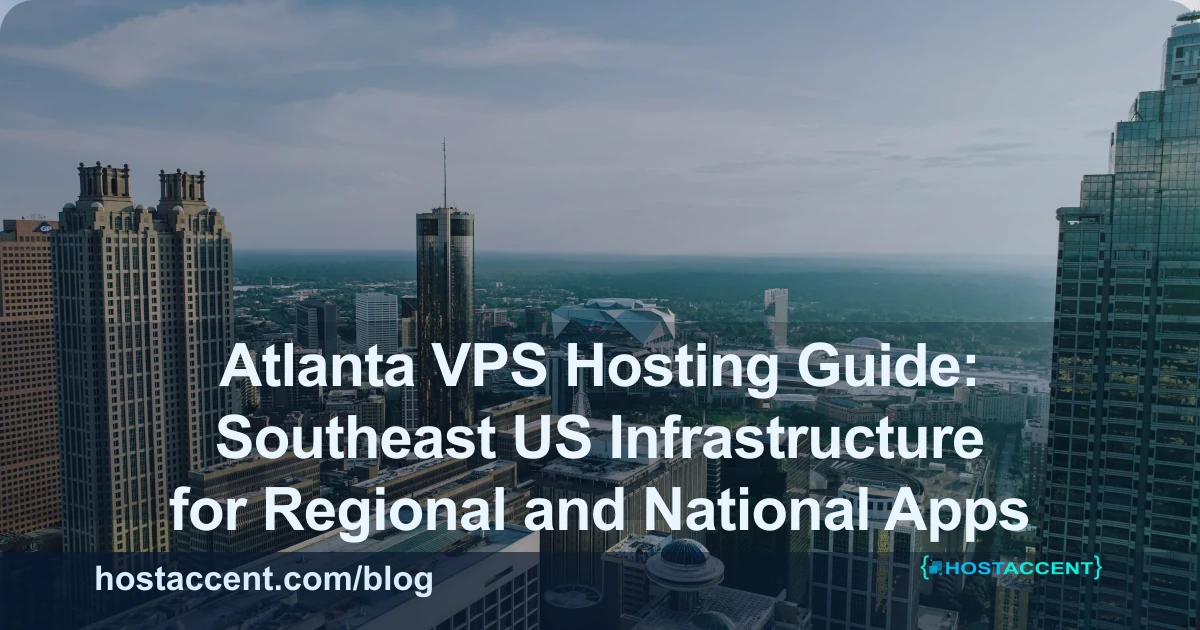
Here's something most people get wrong when picking a US server location: they default to New York or Chicago because those are the "obvious" choices. If your customers are actually in Georgia, Florida, the Carolinas, or Tennessee, that's a mistake that quietly costs you conversion.
Atlanta is the internet hub of the American Southeast. It doesn't get talked about as much as New York or LA, but the infrastructure is serious — NAP of the Americas sits here, one of the most connected carrier hotels in the eastern US. For Southeast-heavy audiences, Atlanta reaches them faster than any alternative.
Atlanta's network position in the Southeast
The Southeast US has historically been underserved by major datacenter markets. New York dominates the Northeast, Dallas anchors the South-Central, and Chicago covers the Midwest. Atlanta fills the gap for a densely populated corridor that stretches from the Carolinas through Georgia, Florida, and into the Gulf Coast states.
Round-trip times from Atlanta:
- Georgia (local): 1–10ms
- South Carolina, North Carolina: 10–20ms
- Tennessee, Alabama: 10–20ms
- Florida (Jacksonville, Tampa): 20–30ms
- Miami: 30–40ms
- Virginia (DC/Northern VA): 20–30ms
- Chicago: 30–40ms
- Dallas: 30–45ms
- New York: 25–35ms
For a business with users primarily in Georgia, the Carolinas, Florida, Tennessee, and Alabama, an Atlanta-based server reaches them faster than any alternative single-location choice. No East Coast datacenter city can claim this for the Southeast specifically.
NAP of the Americas and Atlanta's carrier infrastructure
The NAP of the Americas datacenter in Miami anchors the Southeast's internet infrastructure, but Atlanta's Internap and Coresite facilities provide dense carrier interconnection for the region. AT&T, Comcast, Level 3 (Lumen), and Windstream all have major Atlanta presence. This carrier diversity improves routing paths and gives Atlanta-based servers multiple ways to reach East Coast, Midwest, and South Central destinations.
Atlanta also sits on major fiber routes connecting the Northeast corridor to the Gulf Coast and Texas. Interstate fiber networks running north-south through Atlanta mean the city functions as a natural relay point — traffic flowing between New York and Miami, or between Chicago and New Orleans, often transits Atlanta infrastructure.
Who should choose Atlanta VPS
Southeast US ecommerce brands. If your customers are concentrated in Georgia, Florida, the Carolinas, and Tennessee, Atlanta hosting keeps checkout latency low for the majority of your traffic. For categories like home goods, apparel, and food-and-beverage that have strong regional purchasing bases in the South, local hosting reinforces the performance that conversion rates depend on.
Logistics and supply chain applications. Atlanta is the busiest cargo airport in the world (Hartsfield-Jackson) and a major logistics hub for the Southeast. Distribution companies, freight brokers, and supply chain platforms with regional operations often find Atlanta-based infrastructure reduces latency for their operations software — dispatchers, warehouse management systems, and route optimization tools.
Healthcare applications. The Southeast has significant healthcare infrastructure: Emory, Piedmont, WellStar, and Northside are major health systems in metro Atlanta alone. Healthtech companies building EHR integrations, patient portals, telehealth platforms, or insurance tools for Southeast health systems benefit from Atlanta's proximity.
Media and broadcasting. CNN, Turner Broadcasting (now part of Warner Bros. Discovery), and several major media groups have Atlanta operations. Media technology companies supporting content operations, news platforms, or broadcasting infrastructure often find Atlanta network adjacency valuable for their Southeast clients.
Regional agencies and SaaS businesses. Atlanta has a growing tech ecosystem (tech square at Georgia Tech, growing startup community). SaaS businesses, digital agencies, and software companies serving Southeast US enterprise clients benefit from hosting close to where their customers operate their own systems.
Financial services with Southeast presence. Fiserv, NCR (National Cash Register), and Global Payments are all headquartered in or near Atlanta — it is a significant fintech hub. Payment processing and financial technology companies serving regional banks, credit unions, or retail point-of-sale systems have practical reasons to keep infrastructure in the Southeast.
Production setup for Southeast workloads
US locale and timezone:
- Time zone:
America/New_York(most of Georgia, Carolinas, and Florida are Eastern Time) - Tennessee is split — Nashville is Central, Knoxville is Eastern
- Alabama and Mississippi are Central Time — handle time zones in application code if serving the full South
- Locale: en_US
Performance:
- Nginx with gzip compression for text assets
- Browser cache headers (30-day for static assets)
- PHP-FPM pool sized to available RAM
- Redis for session and object caching
- CDN edge nodes in Atlanta and Miami for Florida traffic; add Dallas edge for Gulf Coast coverage
Security baseline:
- SSH key-based authentication, disable password auth
- UFW firewall (SSH, 80, 443)
- fail2ban for automated brute-force mitigation
- SSL with HSTS enabled after testing
- Regular automated backups to an off-site location
Sizing for Southeast US workloads
| Workload | vCPU | RAM | Storage | |---------|------|-----|---------| | Regional business site / early launch | 2 | 4 GB | 60 GB NVMe | | Active ecommerce or SaaS | 4 | 8 GB | 100 GB NVMe | | High-traffic Southeast platform | 8 | 16 GB | 200 GB NVMe |
Peak traffic considerations for Southeast US:
- College football season (September–January): Georgia, Alabama, Florida, Tennessee, Clemson — regional sports traffic can spike media and ecommerce sites significantly
- Hurricane season (June–November): Logistics, news, and government-adjacent applications see traffic spikes during weather events affecting the Southeast
- Holiday retail: Standard Black Friday/Cyber Monday peaks apply; plan capacity by early November
Atlanta vs Dallas for the South
Atlanta and Dallas are both considered "South" options but serve different geographies:
- Atlanta: Better for East-heavy Southeast (Georgia, Carolinas, Florida, Virginia corridor); stronger East Coast latency (25–35ms to New York)
- Dallas: Better for Texas-primary, Oklahoma, Louisiana, and Southwest traffic; stronger West Coast coverage than Atlanta
For a business with roughly equal Florida and Texas traffic, this is a coin flip — go with whichever provider offers better infrastructure and support at your price point. For East-Southeast concentration, Atlanta wins clearly. For Texas-plus-national, Dallas is more balanced.
Atlanta vs New York for East Coast coverage
New York-area hosting (typically New Jersey datacenters) is often the default East Coast choice. But for Southeast-heavy traffic patterns:
- Atlanta to Georgia/Carolinas/Florida: 10–30ms
- New Jersey to Georgia/Carolinas/Florida: 25–50ms
The difference is real for users in those states. If you do meaningful business in the Southeast and are currently on New York hosting, an Atlanta migration or an Atlanta CDN edge could measurably improve performance for a significant portion of your user base.
Atlanta + CDN for regional coverage
An Atlanta VPS with a CDN handles Southeast-to-national distribution well:
- Dynamic requests (API calls, authenticated pages) served from Atlanta origin
- Static assets (images, CSS, JS) cached at CDN edges in Atlanta, Miami, and Washington DC for East Coast distribution
- Optional Chicago or Dallas CDN edge for Midwest/South-Central coverage
This gives Southeast users fast-feeling dynamic responses while CDN edges handle static delivery for users further afield.
Bottom line
If your analytics show most traffic coming from Georgia, Florida, the Carolinas, or Tennessee — and you're currently on New York or Chicago hosting — you're quietly costing yourself conversion. The latency difference is real and it shows up in bounce rate.
Start with Atlanta VPS plus a CDN. Your Southeast users feel the difference from day one, and you're not overpaying to serve them from the wrong coast.
See HostAccent VPS plans and get started.
HostAccent Cloud Hosting — scalable cloud infrastructure for growing businesses.




Discussion
Have a question or tip about this topic? Share it below — your comment will appear after review.