
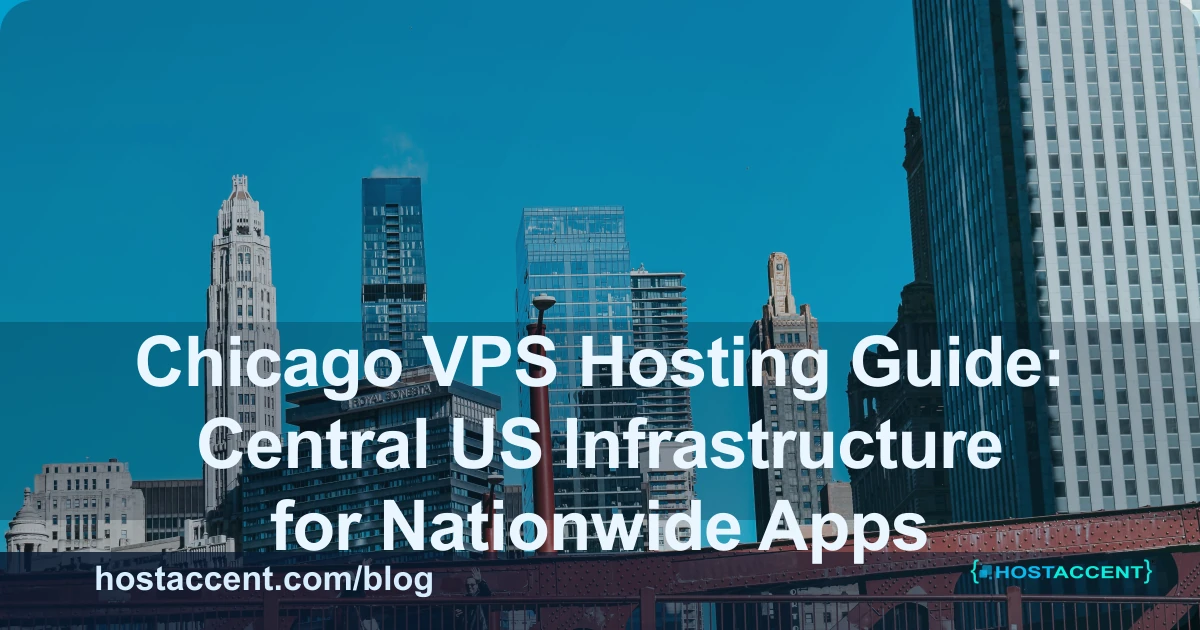
Chicago is the internet crossroads of North America. The ChIX (Chicago Internet Exchange) and the concentration of major network carriers in Chicago's central geographic position give it a unique characteristic among US datacenter locations: it delivers more balanced latency across the entire US than any other single city. So if you are weighing where to buy Chicago VPS capacity, that central reach is the deciding factor.
For businesses serving nationwide American audiences — where you need consistent performance from Maine to California, not just excellence for one coast — Chicago VPS is often the most strategically sound single-location choice.
Chicago's geographic and network position
Chicago sits roughly equidistant between the US East and West Coasts. Major US fiber backbone routes run through Chicago, making it a natural aggregation point for cross-country internet traffic.
Round-trip times from Chicago:
- New York City: 20–28ms
- Boston: 22–30ms
- Washington DC: 20–28ms
- Miami: 35–45ms
- Dallas: 30–40ms
- Denver: 25–35ms
- Los Angeles: 50–65ms
- Seattle: 50–65ms
- Toronto, Canada: 15–20ms
- Vancouver, Canada: 55–70ms
Compare this to Los Angeles (excellent for West Coast, 60–70ms to NYC) or New York (excellent for East Coast, 60–70ms to LA). Chicago achieves under 65ms to all major US metropolitan areas — no location on either coast can say the same.
Who benefits from Chicago's geographic balance
Nationwide US ecommerce. If you ship to all 50 states and your traffic reflects US demographics (concentrated in the coasts but broadly distributed), Chicago origin + CDN gives the most balanced performance nationwide.
US SaaS platforms with distributed enterprise customers. Enterprise software users are everywhere. A Dallas customer, a New York customer, and a Seattle customer should all get a comparable experience. Chicago's position delivers this more naturally than any coast-based alternative.
Canadian businesses with US expansion. Toronto-based businesses serving both Canadian and US markets find Chicago's proximity to Toronto (15–20ms) while maintaining good US coverage a practical advantage.
Media and publishing with national US audiences. News sites, content platforms, and media businesses with nationwide US readership often find Chicago's balanced latency reduces the "slow on the coasts" problem that affects single-datacenter strategies.
Businesses with significant Midwest revenue. Illinois, Michigan, Indiana, Ohio, Wisconsin, and Minnesota users all reach Chicago in 5–20ms. If the Midwest is a significant portion of your market, local hosting reinforces that advantage.
Chicago's network infrastructure
The Chicago Area Network (CAN) and ChIX provide interconnection for Midwest ISPs and enterprise networks. Major US fiber providers — Level 3 (Lumen), Zayo, AT&T, Comcast — all have significant Chicago presence. This carrier diversity means Chicago-based servers have multiple routing options to reach any US destination, which improves reliability as well as latency.
Chicago also serves as a hub for US-Canada connectivity, with major fiber routes to Toronto, Montreal, and Vancouver running through the city.
Market context: Midwest US business
Chicago is the largest business hub in the Midwest and the third-largest city in the US. Major industries include finance (CME Group, the world's largest derivatives exchange, is based in Chicago), logistics and supply chain, manufacturing, and healthcare.
For businesses serving Chicago-area enterprises:
- Financial services applications: Chicago hosts futures and options trading infrastructure (though less equities trading than New York)
- Healthcare: Major health systems in Chicago/Illinois
- Logistics: Major distribution centers and supply chain operations
- Professional services firms across the Midwest
Production setup for Chicago VPS
US locale and time zone:
- Time zone:
America/Chicago(handles CDT/CST — Central Time) - Locale: en_US
- Ensure your application handles all US time zones correctly if serving nationwide users
Performance:
- Nginx gzip compression
- Browser cache headers for static assets (30-day expiry)
- PHP-FPM sized to available RAM
- Redis for object/session caching
- CDN with US edge nodes for coast-to-coast static asset distribution
Security:
- SSH key-based authentication
- UFW firewall (SSH, 80, 443)
- fail2ban
- SSL + HSTS
Sizing for Chicago/nationwide US workloads
| Workload | vCPU | RAM | Storage | |---------|------|-----|---------| | SME website / early launch | 2 | 4 GB | 60 GB NVMe | | Nationwide ecommerce/SaaS | 4 | 8 GB | 100 GB NVMe | | High-traffic US platform | 8 | 16 GB | 200 GB NVMe |
US ecommerce peaks: Black Friday, Cyber Monday, and the pre-Christmas shopping season. Plan capacity well before late November.
Chicago vs Dallas for central US
Both cities are often compared as US central hosting options. The key difference:
- Chicago: Better for East Coast-heavy traffic distributions; stronger Midwest coverage; better Canada connectivity
- Dallas: Better for South-central US and Texas-heavy traffic; slightly better Southwest US coverage; growing tech ecosystem
For nationwide US coverage, Chicago's latency to the East Coast (20–28ms) is better than Dallas's (25–35ms). For Texas-primary or Southwest-primary businesses, Dallas is the better choice.
Chicago + CDN for nationwide coverage
A Chicago VPS with a CDN handles nationwide US distribution effectively:
- Dynamic requests served from Chicago origin
- Static assets (images, CSS, JS) cached at CDN edge nodes in 10+ US cities
- Users in California, Florida, and the Northeast all get static assets from nearby CDN edges
This architecture costs roughly the same as a single VPS + CDN subscription and gives materially better performance than a Chicago VPS alone for users far from the Midwest.
Final recommendation
Chicago VPS is the most strategically sound US single-location choice for nationwide American businesses. Its geographic balance and strong network infrastructure make it consistently competitive across all US regions rather than excellent for one coast and mediocre for the other.
If the Midwest is your primary market, Chicago is the obvious local choice. If nationwide coverage is the goal, Chicago as origin + CDN is a formula that works well without the complexity of multi-region infrastructure.
See HostAccent Chicago VPS plans — reliable Chicago-region infrastructure with NVMe storage and 24/7 support. HostAccent Cloud Hosting — scalable cloud infrastructure for growing businesses.




Discussion
Have a question or tip about this topic? Share it below — your comment will appear after review.