
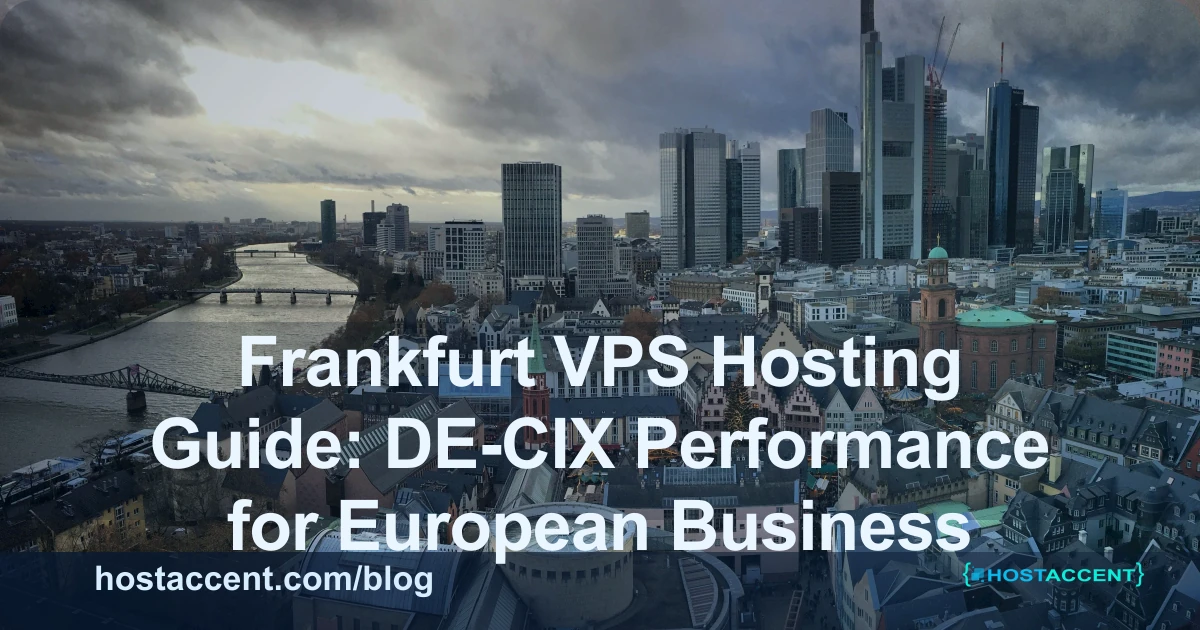
Frankfurt hosts DE-CIX, one of the world's largest internet exchanges. That gives providers in the city access to a dense peering ecosystem, but location alone does not guarantee a good route. A Frankfurt VPS is most valuable when the provider can show strong upstreams, sensible routing, and test addresses for the networks your users actually use.
For businesses scaling across Europe, Frankfurt is not just a hosting location. It is the infrastructure hub of the European internet.
DE-CIX and what it means for your application
DE-CIX connects over 1,000 network participants — German ISPs (Deutsche Telekom, Vodafone Germany, 1&1), European carriers, content distribution networks, and enterprise WANs — through direct peering agreements. When your server sits in Frankfurt with DE-CIX access, traffic from German users reaches it without traversing intermediate transit networks.
The practical benefit can be low-latency routing across Central and Western Europe. The result still depends on the provider's network and peering arrangements, so test before committing.
Round-trip times from Frankfurt:
- Netherlands: 5–12ms
- France: 15–22ms
- UK: 15–25ms
- Poland: 20–35ms
- Switzerland: 10–18ms
- Austria: 15–22ms
- Scandinavia: 25–45ms
- Eastern EU (Czech Republic, Hungary, Romania): 25–40ms
Treat these figures as planning ranges, not promises. Run ping and traceroute tests from the countries that matter to your application because routes vary by ISP and time of day.
Who should choose Frankfurt VPS
Multi-country EU businesses. If your users are distributed across Western and Central Europe, Frankfurt's DE-CIX position gives more consistent latency across all of them than a location optimized for one country.
German market focus. Germany is the largest economy in the EU and one of the top ecommerce markets in Europe. German consumers are data-conscious, legally aware, and expect fast, reliable websites. A Frankfurt server delivers optimal performance for German users specifically.
Teams with an EU data-location requirement. A Frankfurt region can keep stored data in Germany when the provider contract and architecture support that requirement. You still need to review the provider's legal entity, subprocessors, support access, backups, and data-processing agreement; server geography by itself does not establish GDPR compliance.
SaaS products serving European enterprises. B2B SaaS serving customers across several European countries can benefit from Frankfurt's central position and broad network connectivity.
CDN origin servers for European distribution. Major CDNs (Cloudflare, Fastly, Akamai) have large Frankfurt PoPs. Using Frankfurt as a CDN origin server gives the CDN optimal connectivity to pull content from your server for distribution across European edge nodes.
German market specifics
Payment landscape: Germany has unique payment preferences. SEPA Direct Debit, SOFORT (Klarna), and giropay are widely used alongside Visa/Mastercard. German consumers show higher-than-average preference for invoice-based payment (Kauf auf Rechnung) for ecommerce. Payment processors for German consumers (Klarna, Mollie, Stripe) have Frankfurt-region API endpoints.
Legal compliance: Germany's Digital Services Act implementation includes the Digitale-Dienste-Gesetz (DDG), while the BDSG supplements the GDPR in German law. Commercial websites may also have provider-information, privacy, and consent obligations. These depend on the service and organisation, so use current official guidance or qualified legal advice instead of treating the server location as a compliance shortcut.
Language localization: German-language content requires correct grammar, formal address (Sie, not du for B2B), and German locale formatting (day.month.year dates, comma as decimal separator, period as thousand separator).
Production setup for Frankfurt VPS
Security:
- SSH key-based authentication, root login disabled
- UFW firewall: only SSH, 80, 443 open
- fail2ban for SSH and application login protection
- ModSecurity or similar WAF for ecommerce and login-heavy applications
Performance tuning:
- Nginx gzip compression (significant for German mobile users on LTE)
- Browser cache headers on all static assets
- PHP-FPM pool configured to available RAM
- MySQL
innodb_buffer_pool_sizeat 50–70% of RAM - Redis object cache for CMS-based applications
Compliance readiness:
- German-language Impressum and Datenschutzerklärung (privacy policy)
- Cookie consent compliant with German DSK guidance
- Data processing documentation for all processors
Capacity planning for EU workloads
| Stage | vCPU | RAM | Storage | |-------|------|-----|---------| | New EU product / early launch | 2 | 4 GB | 60 GB NVMe | | Active ecommerce or SaaS | 4 | 8 GB | 100 GB NVMe | | High traffic / multi-tenant | 8 | 16 GB | 200 GB NVMe | | Database-heavy applications | Consider separate DB server at this scale |
German ecommerce peak periods: Christmas (Weihnachten) season from November onwards, the January sales, and Amazon Prime-style promotional events. German Black Friday adoption has grown significantly. Plan capacity before these periods.
Frankfurt and the broader EU architecture
For businesses serving a mainly Central-European audience, Frankfurt is a strong single-region starting point. As you scale:
- Add a London VPS or CDN edge for UK-specific low latency (post-Brexit UK users benefit from UK-resident content)
- Add Paris CDN edge for French users
- Consider a Scandinavian node if Nordic traffic becomes significant
CDNs with Frankfurt origins (Cloudflare, Bunny.net, KeyCDN) give you European edge distribution without additional VPS servers. This architecture handles most EU growth scenarios efficiently.
Final recommendation
A Frankfurt VPS is a strong candidate for applications serving Germany and neighbouring European markets. Choose it for measured route quality, operational support, and suitable capacity—not for the city name alone. For the wider country-level decision, including contracts and data-location questions, read the Germany VPS guide.
Start in Frankfurt, add CDN for static asset distribution, and expand to additional servers or locations only when specific market performance data shows a clear need.
See HostAccent Frankfurt VPS plans — reliable Frankfurt-region infrastructure with NVMe storage and 24/7 support. HostAccent Cloud Hosting — scalable cloud infrastructure for growing businesses.



Discussion
Have a question or tip about this topic? Share it below — your comment will appear after review.