
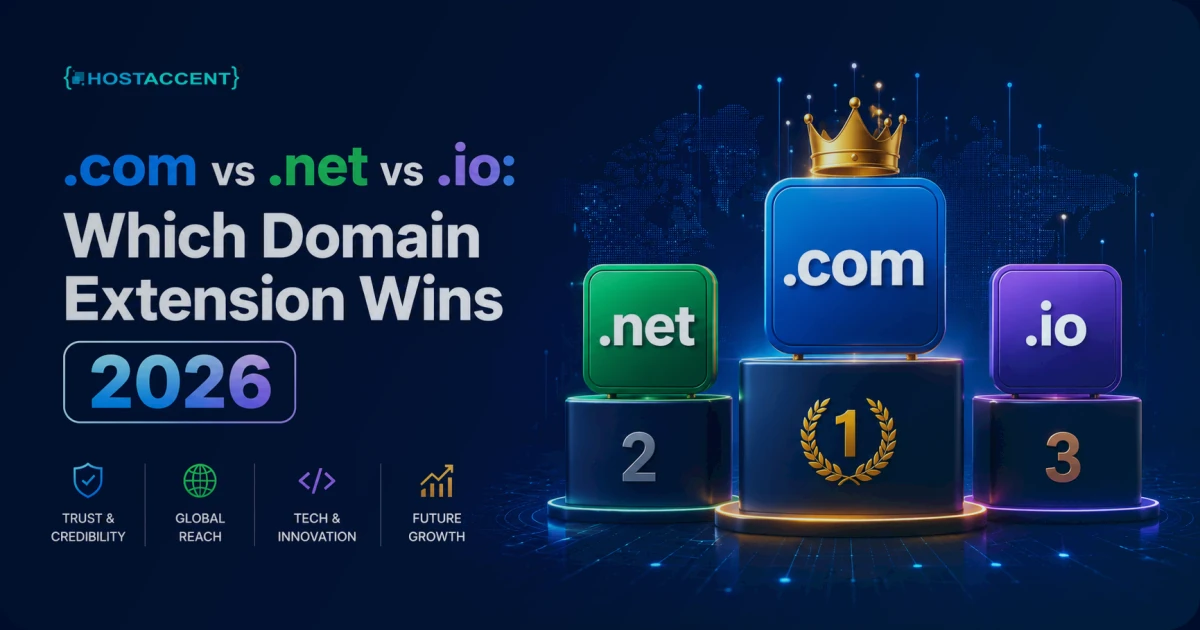
Picking between .com vs .net vs .io feels like a small detail — until you've signed up, printed cards, and realised the extension shapes whether people trust and even find your site. One choice can mean a $12 domain or a $55 one. It can mean a name people remember, or one they keep typing wrong. This guide skips the marketing. You'll get real 2026 prices, a plain-English read on what each extension signals, the one .io risk most articles quietly ignore, and a simple rule for deciding fast.
Quick Answer: For most businesses and personal brands, .com is still the safest pick in 2026 — it's the default people type and the most trusted. Choose .net only if your .com is taken and you lean technical or network-focused. Pick .io for startups, SaaS, and developer tools, but budget $40–$60/year and keep an eye on its uncertain country-code status.
What makes a domain extension worth buying
Before you compare names, get clear on what you're actually paying for. A domain extension (the bit after the dot, also called a TLD) does three jobs: it tells people what kind of site you are, it affects how much you pay every year, and it quietly shapes trust. Cloudflare's explainer on top-level domains is a clean primer if you want the technical version.
Here's the part nobody warns you about: the cheap first-year price is a trap if the renewal triples. Plenty of registrars bury that number. A host like Hostaccent shows the renewal rate next to the first-year price, which is the honest way to do it — and in the domain tickets our support team handles, surprise renewals are one of the most common complaints we see. So weigh four things, in this order:
- Trust and recognition. Does the public instinctively trust this extension? .com wins here by a mile.
- Total cost over five years, not just year one. Renewal is where the real bill lives.
- Stability of the namespace. Is this extension's long-term future settled, or up in the air?
- Fit for your audience. A developer crowd reads .io as "cool." A local plumber's customers may not even know it exists.
If you want the full pre-purchase checklist, our Domain and Hosting Buying Guide: What to Check Before You Pay walks through every line item, including DNS, SSL, and email.
Pro Tip: Whatever extension you launch on, register the .com of your name too if it's available — even just to redirect it. It's $12–$15 of cheap insurance against someone else grabbing your brand or customers typing ".com" out of habit.
The .com vs .net vs .io head-to-head
Let's put the three side by side at a like-for-like, standard-registrar tier. Prices below reflect typical 2026 market ranges across mainstream registrars — your exact number varies by who you buy from.
| Extension | Typical 2026 price/yr | Best known for | Public trust | Watch-out | |-----------|----------------------|----------------|--------------|-----------| | .com | $13–$20 | Anything — the default | Highest | Good names are often taken | | .net | $13–$18 | Networks, infrastructure, tech tools | High | Often read as "the .com backup" | | .io | $44–$60 | Startups, SaaS, developer products | Medium (strong with tech crowd) | Pricey, and its status is unsettled |
A few honest notes on that table.
.com is the global default. In 2025, .com still pulled in roughly 4.67 million new registrations in a single quarter — no other extension is close. Verisign, which runs the registry, charges registrars a wholesale rate of about $10.40 per .com year, so retail prices stay fairly tight. If your brand is the kind a stranger might type from memory, .com is rarely the wrong call.
.net is run by the same registry as .com, so pricing and stability are similar. It started life for network and infrastructure companies, and that flavour still clings to it. The honest downside: most people read a .net as the version someone picked because the .com was gone. That's not fatal — it's just a small trust tax.
.io reads as modern and technical, which is exactly why startups, SaaS apps, and dev tools love it. The catch is cost (often 3–4× a .com) and something deeper we'll cover next.
Insider Insight: When we migrate customer sites, we repeatedly see people who registered a .io for a local business — a café, a clinic, a contractor. Their customers kept landing on the .com that a competitor owned. If your audience isn't technical, a clever extension can actively cost you traffic.
The .io question every buyer should ask in 2026
This is the part the other comparison pages skip, and it matters. The .io extension isn't a generic global TLD like .com — it's a country-code domain (a ccTLD) tied to the British Indian Ocean Territory. In October 2024 the UK agreed to hand sovereignty of those islands (the Chagos Archipelago) to Mauritius, and the treaty was signed on 22 May 2025.
Why should a buyer care? Because country-code domains exist for the territory they represent. ICANN, the body that oversees the domain system, addressed this directly: if the territory's two-letter code is removed from the underlying ISO 3166 standard, ICANN's retirement policy kicks in, opening a five-year window to phase the domain out (a window that can be extended).
Now the calm part, because the headlines oversell the panic. Retirement is only one of several outcomes, and it's not the most likely one. Around 270,000+ active sites — by some counts up to 1.6 million organisations — rely on .io, which is real revenue and real pressure to keep it alive. The registry operator already manages Mauritius's own .mu domain, so a quiet redelegation is plausible. For reference, Anguilla's .ai domain earned its government roughly $32 million in 2023, which is exactly the kind of money that keeps a small nation interested in preserving a valuable extension, not killing it.
So the realistic read for 2026: .io probably survives, but its future is no longer a settled question. If you're choosing today, treat that uncertainty as a real (if modest) risk, not a reason to flee.
Pro Tip: Going with .io anyway? Register the matching .com as a defensive backup and point it at your site. If .io's status ever changes, you can switch your primary address with a redirect instead of a fire drill — and you protect the name from squatters in the meantime.
Best domain extension by use case
There's no universal winner. There's the right pick for your situation. Here's the shortcut.
Choose .com if you run a business, store, or personal brand aimed at a general audience. It's the trusted default and the easiest to say out loud. For a content-heavy or commercial site you plan to grow, .com plus solid hosting is the boring-but-correct combo — see Best Hosting for High Traffic WordPress Sites in 2026 for the infrastructure side.
Choose .net if your ideal .com is taken and your work is genuinely technical — a network service, an ISP, a developer utility, or an internal tools brand. The audience won't blink at it.
Choose .io if you're a startup, SaaS product, API, or developer tool whose customers live in tech. The signal it sends is worth the premium to that audience specifically. If you're shipping an app and need somewhere to run it, pair the domain with the right box — our Best Cheap VPS for Node.js in 2026 guide covers that. We help a lot of these launches at Hostaccent, and the pattern is consistent: tech buyers shrug at .io, mainstream buyers hesitate.
Whatever you pick, two practical jobs follow on day one: a working SSL certificate (free options exist via Let's Encrypt, and our SSL Certificate Management Guide covers setup and renewal), and proper email on your domain — here's How to Create Email With Own Domain.
The renewal-price reality nobody warns you about
This is where most people lose money. The advertised price is the first-year promo. The renewal is the real cost — and the gap can be brutal. Industry data shows a meaningful share of new extensions renew at 2× to 10× their intro price. A name that registers for $1.99 but renews at $19.99 will quietly cost you over $200 across five years.
Run the five-year math before you buy, not after:
- A .com at ~$13/year, every year, costs about $65 over five years.
- A .io at ~$50/year costs roughly $250 over the same stretch — nearly 4× the .com.
- A $1.99 "deal" that renews at $24 costs about $97 over five years, worse than a flat $13/year name.
The fix is simple: ignore the first-year number and look at the renewal number. Hostaccent, for one, keeps registration and renewal pricing visible and close together so there's no year-two ambush. If you'd rather skip the separate domain bill entirely, bundling a domain with hosting is often cheaper for year one — we compared the options in Free Domain With Hosting: 11 Providers That Deliver.
Insider Insight: Before you commit, check whether your registrar charges extra for WHOIS privacy. Some bundle it free; others tack on $10/year. Across the accounts we've helped clean up, that hidden line item is the single most common "why is my domain bill higher than I expected" answer.
Where to register without the renewal trap
So, when you weigh .com vs .net vs .io, the decision usually comes down to three honest questions. Quick recap of what actually matters:
- Trust beats cleverness. For a general audience, .com is still the safest bet in 2026.
- .net is a solid plan B when your .com is taken and your work is technical.
- .io fits tech brands — just budget for the higher price and the unsettled ccTLD status.
- Renewal price is the real price. Always run the five-year total, not the year-one promo.
- Buy the .com backup even if you launch elsewhere.
If you'd rather not juggle a separate registrar and worry about renewal surprises, registering your domain alongside hosting keeps everything — DNS, SSL, email, billing — under one honest login. Hostaccent's Linux shared hosting at /linux-shared-hosting starts at $1.99/Month and includes domain registration, free SSL, and email on your own name, all on our Cloudflare → Nginx → Apache stack with NVMe storage and UK-based support. The honest limitation: a bundled domain is usually free or discounted for year one only, so check the year-two renewal (we show it up front) before you decide. As a UK-registered host serving customers worldwide, we'd rather you pick the right extension than the most expensive one.
<!-- ha:inbound-repair:start -->Related guides: Can I Buy a Domain Without Hosting? Yes, Here's How · How to Change Nameservers: Point Your Domain in 2026 · How to Recover an Expired Domain: Every Stage in 2026
<!-- ha:inbound-repair:end -->Frequently asked questions
Does .com vs .net vs .io affect SEO rankings?
No — Google treats .com, .net, and .io equally for ranking. None gets a built-in boost. What does move rankings is trust and click-through: people click .com results more readily, and a familiar extension earns more direct traffic. So the SEO impact is indirect, through user behaviour, not the extension itself.
Is .io a safe domain to buy in 2026?
It's reasonably safe but no longer a settled question. The UK–Mauritius treaty over the Chagos Islands (signed May 2025) put the .io country-code status in flux. Most signs point to preservation or redelegation rather than shutdown, but ICANN's retirement policy allows a five-year phase-out if the code is ever removed. Buy with a .com backup.
Why is .io so much more expensive than .com?
Registry pricing. The .io registry sets a much higher wholesale rate than Verisign charges for .com, and demand from well-funded startups keeps prices firm. Expect $40–$60/year for .io versus $10–$20 for .com — often a 3–4× difference that compounds at every renewal.
Should I buy all three extensions of my name?
Usually just two: your primary plus the .com as a defensive redirect. Owning all three only makes sense for established brands worried about copycats. For most people, one working extension and a .com backup is plenty — buying every variant mostly enriches your registrar.
Is .net as good as .com?
For function, yes — same registry, same stability, same SEO treatment. For perception, slightly less. Many users read .net as the fallback someone took when the .com was gone. If your .com is available, take it. If not, .net is a respectable, trusted choice, especially for technical brands.
Can I move from .io to .com later without losing traffic?
Yes, with care. Set up 301 redirects from every .io URL to the matching .com page, update your sitemap, and keep both domains live during the switch. Most ranking and traffic carries over within weeks. A DNS misstep is the usual snag — our guide on fixing DNS errors helps if you hit one.



Discussion
Have a question or tip about this topic? Share it below — your comment will appear after review.