
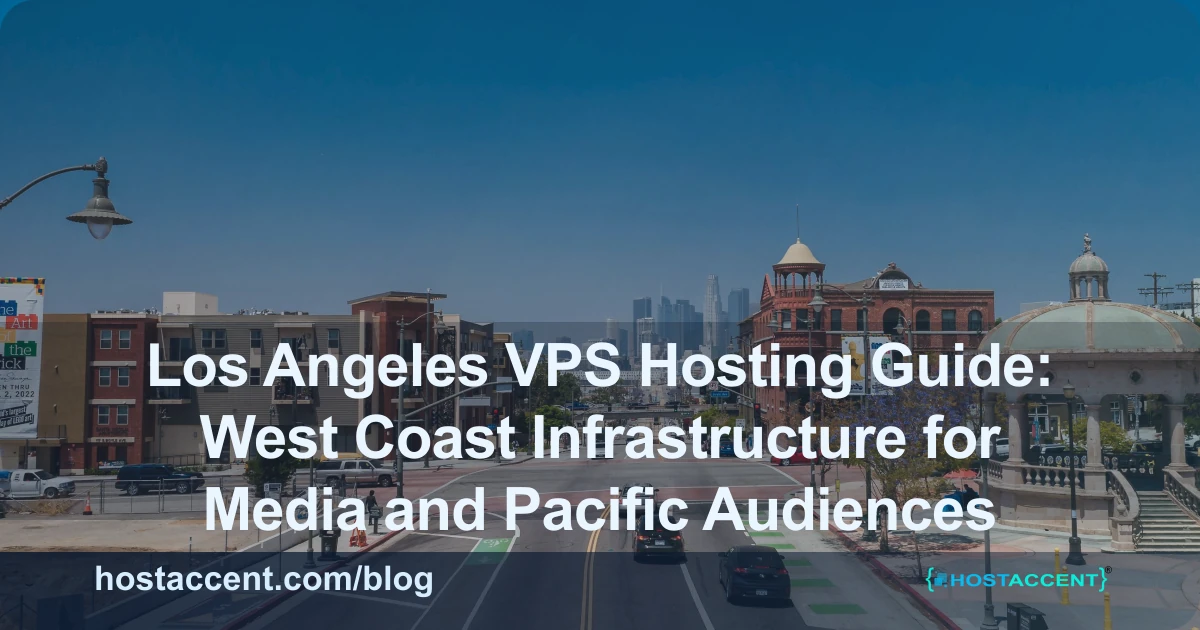
If you're building something for California users, or you have customers in Japan, South Korea, or Australia alongside a US audience — LA is probably the smartest single server location you can pick. For a media website, a VPS in LA pairs low latency with the bandwidth that heavy assets demand.
Here's why: Los Angeles is where the transpacific submarine cables come ashore. That's not marketing language, it's physical infrastructure. A server in LA has shorter, faster paths to Tokyo and Sydney than any other US city. At the same time, it's the natural home for Southern California users and the entertainment and media industry built around them.
LA's network position: Pacific gateway
Several major transpacific submarine cables land near Los Angeles — including cables connecting to Japan, South Korea, Australia, and the Philippines. This makes LA-based servers uniquely positioned for applications that serve both US West Coast and Asia-Pacific audiences from a single location.
Round-trip times from Los Angeles:
- California (Southern): 1–10ms
- Las Vegas, Phoenix: 10–20ms
- San Francisco: 10–20ms
- Seattle: 25–35ms
- Denver: 25–35ms
- Chicago: 50–65ms
- New York: 60–75ms
- Tokyo: 100–130ms
- Seoul: 110–140ms
- Sydney: 120–150ms
- Singapore: 140–170ms
The contrast with East Coast hosting is stark: LA reaches Tokyo in roughly 110–130ms, while a New York server reaches Tokyo in 180–220ms. For businesses serving Pacific Rim markets alongside US users, LA is the natural single-location starting point.
Who benefits most from Los Angeles VPS
West Coast US businesses. California has the largest state economy in the US and one of the highest concentrations of tech companies, ecommerce brands, and digital businesses. If your customers are in Southern California, the Bay Area, or the broader Pacific Coast, LA hosting minimizes round-trip latency for your largest user base.
Media and entertainment platforms. Los Angeles is the entertainment capital of the world — home to major studios, streaming companies, music labels, and gaming publishers. Media technology companies, post-production software, content distribution platforms, and digital asset management systems serving LA-based entertainment clients have good reasons to keep infrastructure close. Media files are large; every saved millisecond per request adds up across heavy asset workflows.
Video game publishers and gaming platforms. Game streaming, multiplayer lobbying systems, and game update distribution all benefit from West Coast hosting when the player base concentrates in California, the Pacific Northwest, and Pacific Asia. LA reduces latency for US players while remaining competitive for early Asia-Pacific markets.
E-commerce with California-heavy traffic. California represents roughly 12% of US GDP and has outsized ecommerce spending. For brands with California as their single largest state market, LA hosting means your highest-value customer segment gets the best latency.
Asia-Pacific businesses with US West presence. Japanese, Korean, Taiwanese, and Australian companies expanding to the US West Coast often choose LA as their US hosting location specifically because of transpacific cable proximity. A Korean SaaS expanding into the US market can reach both Korean users and US West users more efficiently from LA than from any other US location.
Streaming and content delivery. Major CDN providers (Cloudflare, Akamai, Fastly, Bunny.net) all have large LA PoPs, making an LA-origin VPS well-connected to CDN infrastructure. Static assets origin-pulled from LA distribute efficiently to CDN edges across the US West and Pacific.
LA vs San Francisco (Bay Area) for West Coast hosting
Both cities offer West Coast advantages. The practical difference:
- Los Angeles: Better transpacific latency (cable landing points closer to LA); larger entertainment and media ecosystem; lower VPS pricing than Bay Area alternatives
- San Francisco/Bay Area: Slightly better latency to Seattle and Pacific Northwest; stronger tech startup ecosystem adjacency; closer to major Bay Area enterprise clients
For most West Coast applications, LA and Bay Area are interchangeable. For Pacific-facing applications or media-heavy workloads, LA's cable proximity makes it the stronger choice. For Bay Area-specific enterprise clients, hosting closer to San Jose may be worth the premium.
Production setup for LA/West Coast workloads
US locale and timezone:
- Time zone:
America/Los_Angeles(handles PDT/PST — Pacific Time) - If serving mixed US time zones, handle time zone logic in application code
- Locale: en_US
Performance configuration:
- Nginx with gzip compression — critical for media-rich pages
- WebP image format support (significant file size reduction for California tech-savvy audiences)
- Browser cache headers for static assets (30-day expiry)
- PHP-FPM pool or Node.js cluster sized to available RAM
- Redis for session and object caching
- CDN with US West edge nodes and Pacific Rim PoPs
Security:
- SSH key-based authentication, disable root password login
- UFW firewall (SSH, 80, 443)
- fail2ban for brute-force protection
- SSL with HSTS
- Rate limiting on API endpoints — LA-origin servers face high automated traffic volumes given their public profile
Sizing for West Coast and media workloads
| Workload | vCPU | RAM | Storage | |---------|------|-----|---------| | CA business site / early launch | 2 | 4 GB | 60 GB NVMe | | West Coast ecommerce or SaaS | 4 | 8 GB | 100 GB NVMe | | Media platform / high traffic | 8 | 16 GB | 200+ GB NVMe |
Media and entertainment workloads often need more storage than typical web applications—budget for this if you are storing or serving large files directly. Storage throughput matters, although a CDN or object-storage service is often a better delivery layer for large public assets.
Peak traffic considerations:
- Award show season (Oscars, Grammys, Emmys): Media and entertainment sites see significant traffic spikes during major LA-originated events
- Black Friday/Cyber Monday: Standard US retail peaks
- Gaming launch windows: Game publishing and distribution platforms see traffic spikes at new title launches or major update releases
LA + CDN for national and Pacific distribution
An LA VPS with CDN handles US-wide and Pacific distribution well:
- Dynamic requests (APIs, auth, checkout) served from LA origin
- Static assets cached at CDN edges across US West, US East, and Pacific Rim
- For users in Tokyo, Sydney, or Seoul, CDN edges reduce latency for static content while LA origin handles dynamic requests
This architecture costs roughly the same as an LA VPS subscription plus a CDN plan and materially outperforms LA-only serving for users outside Southern California.
Bottom line
LA VPS is the right call if your users are California-concentrated, or if you need one location that works decently for both US West and Pacific Rim. No other US city gives you that combination.
Start with LA VPS and a CDN. When your traffic data shows Tokyo or Sydney growing, add a CDN edge there — you don't need a second server until you're doing serious volume in those markets.
View HostAccent LA VPS plans and get started today.
LA Internet Exchange Infrastructure and Pacific Connectivity
Los Angeles is the US's primary Pacific Rim internet gateway — a distinction that makes it uniquely valuable for trans-Pacific workloads.
Internet exchanges in the LA metro:
- LSIX (Los Angeles Internet Exchange) — located at CoreSite LA1 (Wilshire Blvd) and Equinix LA1/LA4
- CAIX (California Internet Exchange) — operates in LA metro
- LAX-IX (LA Metro Internet Exchange) — used by regional ISPs and content networks
Submarine cables connecting through LA:
- Trans-Pacific Express (TPE) — Los Angeles to Japan, South Korea, China
- Unity/EAC — Los Angeles to Japan (Google-partnered)
- PC-1 (Pacific Crossing-1) — Los Angeles to Japan
- Monet — Los Angeles to Brazil (fastest US-Brazil link)
- AAG (Asia-America Gateway) — Los Angeles to Southeast Asia via Guam
This cable concentration makes LA the US's lowest-latency location for trans-Pacific traffic. A server in LA reaches Tokyo 10–15ms faster than one in Seattle or San Francisco using identical routes.
Latency from Los Angeles — Real Benchmark Data
| Destination | Round-trip (ms) | |-------------|----------------| | San Francisco | 12–22ms | | Las Vegas, NV | 15–25ms | | Phoenix, AZ | 20–32ms | | Seattle, WA | 35–48ms | | Denver, CO | 40–55ms | | Dallas, TX | 45–60ms | | Chicago, IL | 55–70ms | | New York | 65–80ms | | Tokyo, Japan | 110–130ms | | Sydney, Australia | 140–165ms | | São Paulo, Brazil | 115–135ms |
Latin America: LA + Monet cable gives the lowest US-Brazil latency available. For businesses targeting Brazilian users from a US hosting point, LA consistently outperforms New York, Miami, and Dallas for São Paulo and Rio de Janeiro traffic.
US East Coast: At 65–80ms to New York, LA requires a CDN for coast-to-coast coverage. Without a CDN, a LA-hosted site will feel measurably slower to New York users than a NJ-hosted alternative.
LA Market Context: Media, Entertainment, and Pacific Commerce
Los Angeles is the US center for media, entertainment, and streaming infrastructure. More Fortune 500 media companies operate in LA than in any other US city.
Major LA-based tech and media companies: Snap (Santa Monica), Riot Games (Santa Monica), Disney Streaming (Burbank), Hulu (Santa Monica), YouTube (significant LA presence). The gaming industry in LA is among the US's densest clusters.
Gaming latency requirements: Competitive multiplayer gaming demands server-to-player round-trips below 30ms. For players in Southern California, Arizona, Nevada, and Baja California Mexico — LA hosting achieves the lowest possible ping of any US location. Game server infrastructure for West Coast player bases belongs in LA.
Pacific Rim commerce: LA's time zone (PST/PDT) aligns morning hours with Japan's evening — a practical overlap for live customer support and real-time integrations between US and Japanese business systems.
CCPA: Like all California hosting, applications serving California residents must comply with CCPA/CPRA (see regulatory section in the Silicon Valley guide for full detail). The LA market has a high concentration of entertainment, media, and DTC e-commerce companies — CCPA compliance is essentially a baseline requirement for operating in this ecosystem.





Discussion
Have a question or tip about this topic? Share it below — your comment will appear after review.