
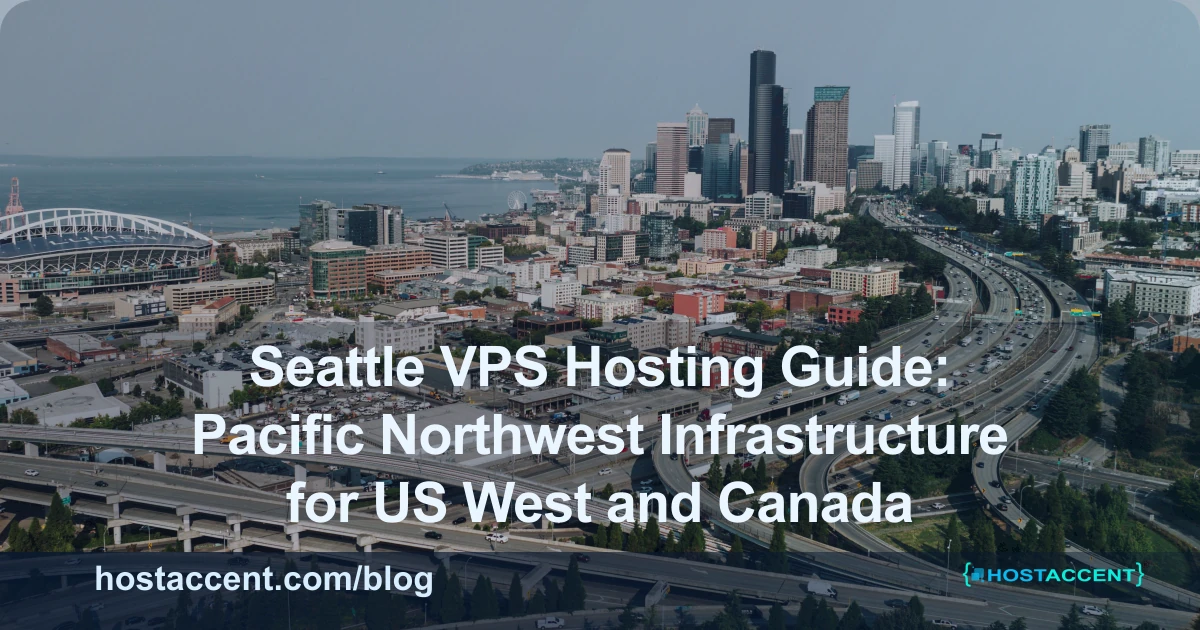
There's a reason Amazon and Microsoft both built their primary datacenters in the Seattle region. The Pacific Northwest has excellent fiber infrastructure, and Seattle sits at a geographic sweet spot: 10–20ms from Vancouver BC, 20–30ms from San Francisco, and with decent Pacific routes toward Tokyo and Seoul. So before you buy Seattle VPS capacity, weigh those Pacific routes against where your users sit.
For business teams that want Seattle-region performance without self-managing every server layer, a HostAccent Seattle VPS is usually the most practical first option to evaluate.
If your users are in Washington, Oregon, or British Columbia — or you're a Canadian company testing the US market — Seattle is probably the most natural US VPS location you can pick. You don't need to think too hard about it.
For businesses targeting the Pacific Northwest, British Columbia, or cloud-adjacent technical workloads, Seattle VPS offers geographic and ecosystem advantages worth understanding.
Seattle's network position
Seattle sits at the northwest corner of the continental US, which gives it a distinctive latency profile relative to other West Coast cities.
Round-trip times from Seattle:
- Washington State (local): 1–10ms
- Oregon (Portland): 5–10ms
- British Columbia (Vancouver, Canada): 10–20ms
- San Francisco/Bay Area: 20–30ms
- Los Angeles: 25–35ms
- Denver: 30–40ms
- Chicago: 55–65ms
- New York: 65–75ms
- Tokyo: 90–120ms
- Seoul: 100–130ms
Seattle's proximity to Vancouver, BC (10–20ms) is unique among US datacenter cities — it is by far the best US location for serving both US Pacific Northwest and Canadian west coast users simultaneously. No other major US datacenter market can claim sub-20ms to both Seattle-area and Vancouver users.
Who should choose Seattle VPS
Pacific Northwest businesses. Washington State, Oregon, and Idaho together represent a significant and growing tech economy. Amazon, Microsoft, Boeing, Starbucks, Costco, and REI all call the Seattle area home — as does a dense ecosystem of SaaS companies, tech startups, and enterprise software firms that serve them. For businesses headquartered in or primarily serving the Pacific Northwest, Seattle hosting gives local-feeling latency for the majority of users.
US-Canada west coast businesses. The corridor from Seattle to Vancouver, BC to Victoria is economically integrated in ways that matter for many businesses. Canadian ecommerce brands expanding to the US Pacific Northwest, and US companies with significant British Columbia customer bases, both benefit from Seattle's geography. At 10–20ms, Seattle reaches Vancouver with the same speed that New Jersey reaches Manhattan — effectively local.
Cloud-adjacent technical workloads. Microsoft Azure's primary US West datacenters are in the Seattle region. Amazon AWS us-west-2 (Oregon) is a short fiber hop from Seattle. For applications that integrate tightly with Azure or AWS services — Blob Storage, Azure Functions, S3, Lambda — a Seattle VPS that communicates with those services over short local connections can be meaningfully faster than communicating from California or elsewhere. If your application makes frequent API calls to Azure or AWS services hosted in the US West region, co-location reduces those call latencies.
Aerospace and defense technology. Boeing's commercial aircraft division is headquartered in Seattle. Joint Base Lewis-McChord and Naval Station Everett are nearby. Software and technology companies serving aerospace and defense contractors in the Pacific Northwest have customer infrastructure concentrated in this region.
Clean energy and sustainability technology. Washington State's hydroelectric power infrastructure (Columbia River system) has made it a hub for energy-intensive computing and sustainability-focused technology companies. Startups in clean energy, grid technology, and environmental monitoring increasingly base themselves in Seattle. SaaS platforms serving this ecosystem find Seattle hosting practically aligned.
Gaming companies. Valve (Steam), ArenaNet, Big Fish Games, and Bungie are Seattle-area gaming companies. The Pacific Northwest has a dense gaming developer ecosystem. Gaming platforms and developer tool companies serving this cluster have customer concentrations in the region.
Canadian businesses with US West expansion. Vancouver is one of the most active tech hubs in Canada. Canadian companies — particularly BC-headquartered tech businesses — expanding to the US West Coast often treat Seattle as the natural first US market precisely because of geographic proximity and cultural alignment. Seattle VPS gives these businesses a cost-effective US infrastructure footprint before they are ready for a full AWS or Azure commitment.
Seattle vs Los Angeles for West Coast hosting
Both cities serve the US West Coast well, but with different strengths:
| Factor | Seattle | Los Angeles | |--------|---------|-------------| | Pacific Northwest latency | Excellent (1–10ms local) | Good (25–35ms) | | Vancouver, Canada | 10–20ms | 40–55ms | | Bay Area | 20–30ms | 10–20ms | | Southern California | 25–35ms | 1–10ms local | | Tokyo (transpacific) | 90–120ms | 100–130ms | | Sydney | 140–160ms | 120–150ms |
Seattle is the better choice for Pacific Northwest + Canada coverage. Los Angeles is better for Southern California, transpacific cable access, and entertainment/media workloads. For equal North-South California coverage, Bay Area/San Jose is the midpoint.
Production setup for Seattle workloads
US locale and timezone:
- Time zone:
America/Los_Angeles(Washington and Oregon are both Pacific Time) - British Columbia users:
America/Vancouver— same offset as Seattle but important to handle separately for Canadian users with local formatting expectations - Locale: en_US for US users; en_CA for Canadian users (different date formats and some different spellings)
Canada-specific considerations:
- British Columbia GST/PST tax rules differ from US sales tax — handle separately in ecommerce platforms
- Canadian users expect metric units alongside or instead of imperial in some contexts
- CAD currency formatting if serving Canadian ecommerce
Performance configuration:
- Nginx with gzip/Brotli compression
- Browser cache headers for static assets (30-day expiry)
- PHP-FPM pool or Node.js cluster sized to RAM
- Redis for session and object caching
- CDN with US West and Canadian edge nodes (Cloudflare has Seattle and Vancouver PoPs)
Security:
- SSH key-based auth, disable password login
- UFW firewall (SSH, 80, 443)
- fail2ban
- SSL with HSTS
Sizing for Pacific Northwest workloads
| Workload | vCPU | RAM | Storage | |---------|------|-----|---------| | PNW business site / early launch | 2 | 4 GB | 60 GB NVMe | | US-Canada ecommerce or SaaS | 4 | 8 GB | 100 GB NVMe | | High-traffic West Coast platform | 8 | 16 GB | 200 GB NVMe |
Peak traffic considerations for Seattle:
- Amazon Prime Day (July): The Pacific Northwest notices Amazon events heavily — both consumer traffic and AWS-driven infrastructure spikes affect the region
- Black Friday/Cyber Monday: Standard US retail peaks
- Canadian holidays: Boxing Day (December 26) is a major Canadian shopping day — businesses serving BC users should plan for this
Seattle + CDN for West Coast and Canada coverage
A Seattle VPS with a CDN handles Pacific Northwest and western Canada distribution well:
- Seattle origin for dynamic content
- CDN edges in Seattle, San Francisco, Los Angeles, and Vancouver for static asset distribution
- This configuration gives Washington/Oregon users and BC users near-identical latency for static assets while keeping dynamic request infrastructure centralized
For businesses where California is also a significant market, adding a Los Angeles CDN edge closes the gap for Southern California users without requiring a second origin server.
Bottom line
Pacific Northwest user base? Seattle. Canadian west coast expansion into the US? Seattle. Azure or AWS US West integrations? Seattle.
No other major US city gives you sub-20ms to Vancouver alongside solid West Coast coverage. Start with Seattle VPS plus CDN, add California edges when your traffic data shows it's worth it.
See HostAccent Seattle VPS plans and get started.
SIX and Seattle's Network Infrastructure
SIX (Seattle Internet Exchange) is one of the United States' largest internet exchanges — notable for being operated by the University of Washington as a non-profit, unlike the commercial exchanges that dominate most US markets. This structure keeps costs low and makes SIX accessible to smaller ISPs, academic networks, and community providers that wouldn't typically participate in commercial exchanges.
SIX is located at the Westin Building Exchange (2001 6th Ave, Seattle) — one of North America's most important carrier-neutral facilities, hosting 300+ network providers across multiple floors.
Seattle submarine cable connections:
- FASTER (Google-operated) — Seattle to Japan and Guam
- PC-1 (Pacific Crossing-1) — Seattle area to Japan
- NCP (North Pacific Cable) — to Japan, South Korea, and the Russian Far East
- Onward connectivity to Asia via Oregon landing stations at Hillsboro and Bandon
Cloud proximity: Microsoft (Redmond, 15 miles east) and Amazon (South Lake Union, 1 mile south) both operate their own backbone networks from Seattle. VPS providers in Seattle with direct on-net routes to Azure and AWS benefit from lower latency to Azure West 2 (Quincy, WA) and AWS us-west-2 (Oregon) than providers routing through California.
Latency from Seattle — Real Benchmark Data
Seattle's latency profile reflects its northwestern US position — excellent for Canada and the Pacific, competitive for the US West Coast, moderate for US-nationwide coverage.
| Destination | Round-trip (ms) | |-------------|----------------| | Vancouver, BC (Canada) | 4–12ms | | Portland, OR | 10–18ms | | San Francisco | 25–38ms | | Los Angeles | 35–50ms | | Phoenix, AZ | 45–60ms | | Denver, CO | 48–62ms | | Chicago, IL | 60–75ms | | New York | 70–85ms | | Tokyo, Japan | 110–128ms | | Seoul, South Korea | 120–140ms |
Seattle is the closest major US city to Canada's Pacific coast — Vancouver BC at 4–12ms. For US-Canada businesses, Seattle is the natural anchor that avoids the latency penalty of routing Canadian traffic through California.
Washington State and Pacific Northwest Regulatory Context
Washington My Health MY Data Act (HB 1155): Signed April 2023, effective March 2024. One of the US's strictest health data laws. Applies to any business collecting "consumer health data" from Washington residents — defined broadly to include wellness apps, fitness trackers, and mental health platforms, not just HIPAA-covered healthcare providers.
Washington Consumer Protection Act (CPA): Washington's state AG has been among the most active in the US against tech companies' deceptive data practices. No separate Washington comprehensive privacy law yet exists (as of 2024), but enforcement under CPA is significant.
Microsoft Azure proximity: Companies deeply integrated with Microsoft 365, Teams, or Azure often choose Seattle-region VPS for lower latency to Azure West 2 (Quincy, WA). This applies to ISVs building on the Microsoft commercial marketplace and managed service providers running Microsoft 365 tenant management.
AWS Oregon (us-west-2): AWS's primary US West region is in Oregon — accessible from Seattle via direct fiber at under 10ms. Seattle VPS + AWS us-west-2 is a low-latency hybrid architecture for applications combining on-VPS compute with managed AWS services.
Seattle Market: Technology, Gaming, and US-Canada Connectivity
The Cascadia tech corridor: Seattle and Vancouver BC are increasingly treated as a single bi-national tech labor market — companies with operations in both US and Canada use Seattle as a natural geographic and infrastructure anchor.
Canadian market reach from Seattle: Bell Canada, Rogers, and Telus (Canada's three major ISPs) peer at Seattle exchanges. Seattle-hosted content reaches:
- British Columbia: 4–12ms
- Alberta: 25–40ms
- Ontario/Quebec: 60–75ms (via cross-country fiber)
Gaming industry: Seattle is one of the US's most concentrated gaming markets. Valve (Steam) and Bungie (Destiny franchise) are headquartered in Bellevue/Kirkland; ArenaNet (Guild Wars) and PopCap (Bejeweled) are Seattle-founded. For West Coast gaming server infrastructure, Seattle achieves 25–40ms to Bay Area players and 35–50ms to Southern California — competitive for multiplayer titles targeting Pacific time zone players.
Industrial IoT: Washington has major aerospace, agriculture, and timber industries. Industrial IoT and supply-chain SaaS serving Pacific Northwest operations can use Seattle hosting to reduce latency to factory floors and logistics systems in the region.




Discussion
Have a question or tip about this topic? Share it below — your comment will appear after review.