

Here's the straight answer, before the caveats: the cost to hire someone to build a website in 2026 typically lands between $500 and $2,500 for a freelancer-built small business site, $3,000 to $10,000 for an agency build, and a few hundred dollars for a done-for-you setup service that bundles the domain, hosting, and build into one job.
Quick Answer: Expect $500–$2,500 for a solid freelancer build, $3,000–$10,000+ from an agency, plus $15–$150/month in ongoing costs like hosting and maintenance either way. The biggest price swings come from scope — page count, e-commerce, custom features — and from who you hire. The technology itself is the cheap part.
Most pricing guides stop at vague ranges and leave you to guess. This one won't. We run hosting infrastructure for small businesses across the US, UK, Canada, and Australia, and a host like Hostaccent ends up seeing the receipts — the invoices customers paid, the half-finished projects they bring us after a build went sideways, and the quiet monthly fees nobody warned them about. That view from the server side is exactly what's missing from most quotes. (For the full component-by-component breakdown, see How Much Does a Website Cost in 2026? Full Breakdown.)
Let's price this properly.
What Drives the Cost to Hire Someone to Build a Website?
Four things move the number more than anything else.
Scope. A 5-page brochure site (home, about, services, contact, one landing page) is a fundamentally different job from a 40-product store with payments and shipping rules. Every page, form, and integration adds hours — and hours are what you're buying.
Who builds it. A junior freelancer overseas, a senior freelancer in your own market, and a full agency team can quote the same project at prices 10x apart. More on real rates below.
Platform. A site built on a mainstream CMS like WordPress costs far less than custom code, because the builder isn't reinventing menus, forms, and content editing from scratch.
Performance and polish. A site that merely exists is cheap. A site that loads fast enough to keep visitors — and page speed genuinely affects conversions — takes optimization work: image compression, caching, a properly configured server. That's real labor, and good builders charge for it.
One more honest driver: your own clarity. Vague briefs generate padded quotes. A one-page document listing your pages, features, and examples of sites you like can shave 20–30% off a quote simply by removing the builder's risk.
Freelancer vs Agency: Real Rates in 2026
Based on industry data as of July 2026, here's what the market actually charges. The website development cost small business owners most commonly pay for a quality freelancer build clusters between $1,500 and $5,000 — and the price to build a website professionally through an agency starts roughly where freelancer pricing ends.
| Who you hire | Typical hourly rate | Typical small business project | Timeline | |---|---|---|---| | Budget freelancer (offshore/junior) | $15–$30/hr | $300–$1,000 | 1–3 weeks | | Experienced freelancer | $45–$90/hr | $1,500–$5,000 | 2–4 weeks | | Agency | $50–$85/hr (often more) | $3,000–$10,000+ | 6–12 weeks | | Done-for-you setup service | Flat quote | Quote-based (infrastructure from ~$2/mo) | Days, not weeks |
A few realities behind those numbers:
- US-based freelancers average around $45/hr; specialists in e-commerce or custom code can run $100–$200/hr.
- Agency quotes include people you never meet — project managers, QA, account handlers. You're paying for process and accountability, not just design.
- The cheapest quote is often the most expensive. In our experience, sites built at rock-bottom rates come back for paid rework within a year — broken plugins, no backups, security holes. You pay twice.
Pro Tip: Never accept a single lump-sum number. Ask for an itemized quote: design, development, content entry, domain, hosting, SSL, and post-launch support as separate lines. The builders who refuse to itemize are usually the ones hiding margin in the vague parts.
The Hidden Costs Nobody Puts in the Quote
Here's the part most pricing articles skip — and the part we see cause the most frustration. The build fee is not the whole bill. A real website carries small recurring costs, and knowing them upfront means no surprises.
Domain name: $13.99/yr. Your domain is your address on the internet (the "yourbusiness.com" part). A .com, .net, or .org registers and renews at $13.99/yr — flat, no renewal jump. A .xyz is cheaper to grab at $3.99/yr but renews at $12.99/yr, so budget for the renewal, not the teaser. You can register your domain in a couple of minutes; if you're unsure what to pick, start with How to Choose a Domain Name in 2026 and the .com vs .net vs .io comparison.
Hosting: from $1.99/mo. Hosting is the server your website physically lives on — no hosting, no website. Some builders quietly resell hosting at $20–$30/mo markup. Buying it directly is far cheaper: Hostaccent's Economy shared hosting plan runs $1.99/mo and renews at $1.99/mo, on NVMe SSD storage with a 99.9% uptime target and a standard control panel. (Fair warning: an entry plan suits brochure sites and small stores — a high-traffic shop will eventually need more server than that.)
SSL certificate: often free, sometimes billed. SSL is the padlock that encrypts traffic between visitors and your site — Google effectively requires it. Free certificates exist and any decent host installs them; if someone quotes you $50–$100/yr for "SSL," question it.
Professional email: small but essential. [email protected] beats a free webmail address for trust. It rides on your domain and hosting — here's how to create email with your own domain.
Maintenance: $15–$150/mo. Updates, backups, security patches, the occasional "the site is down" moment. Skip it and small problems compound.
Don't want to handle any of this yourself? Hostaccent's team sets up everything — domain, hosting, SSL, and your live website — start to finish. Tell us what you need and we'll handle the rest. One message, zero technical work.
The DIY Path: What Building It Yourself Really Takes
Honesty first: you can do this yourself, and for some people it's the right call.
The tools are free or cheap. WordPress itself costs nothing and the official WordPress documentation is genuinely good. A decent theme is free–$60. Add the domain and hosting figures above and a DIY site's hard costs can stay under $50 for the first year.
What it actually costs you is time. Budget 40–60 hours for a first site: choosing and learning the platform, wrestling a theme into your brand, writing every page, setting up forms, connecting the domain's DNS (the system that points your name at your server), and testing on mobile. If you want custom touches, expect to pick up some HTML, CSS, and JavaScript fundamentals along the way.
Do it if: you enjoy learning tools, your time isn't billable elsewhere, and your site is simple.
Skip it if: 50 hours of your working time is worth more than a build fee — for most business owners charging even $30/hr for their own work, it is.
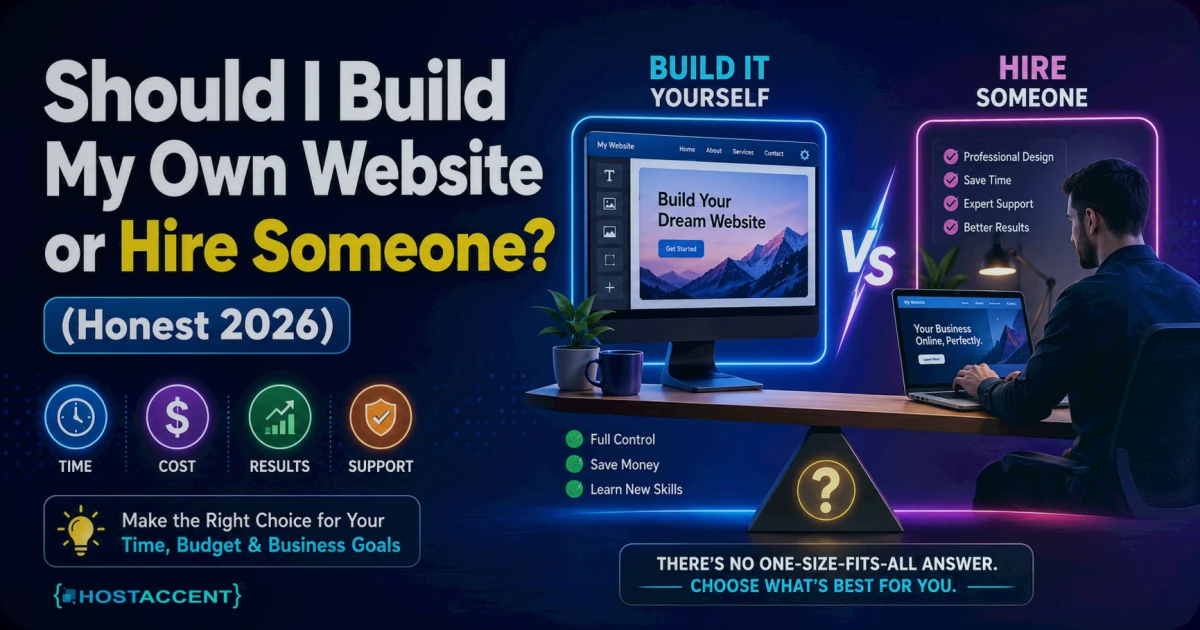
There's no shame in either answer. The math is just the math — and if you want it laid out side by side, hours against dollars, that's what our full build-or-hire breakdown is for.
The Done-for-You Path: What a Full A-to-Z Setup Includes
The middle option most guides ignore: instead of hiring a designer and buying hosting and configuring everything, one provider does the entire chain. A proper full-package setup covers:
- Domain registration in your name (you own it — non-negotiable)
- Hosting configured and connected, DNS pointed correctly
- SSL installed so the site is secure from day one
- The website itself built and launched — pages, contact form, mobile-ready
- Backups and updates handled ongoing, so you're never alone when something breaks
In the setup tickets our team handles, the most common reason people come to us isn't that DIY was impossible — it's that they stalled at the wiring: domain bought in one place, hosting in another, DNS pointing nowhere, SSL never installed. A bundled setup removes every one of those seams, and turnaround is typically days, with the infrastructure live within 24–72 hours.
One honest limitation: if you love tinkering and plan to redesign pages every weekend yourself, a done-for-you service matters less to you — you'll outgrow the "done" part quickly. And if your site later becomes a heavy application, you'd step up to something like fully managed VPS hosting rather than shared infrastructure.
How to Decide Without Overpaying
Skip the agony. Use this:
- Choose DIY if your site is under ~5 pages, you have 40+ spare hours, and you enjoy the learning curve.
- Choose a freelancer if you have a $1,500–$5,000 budget, a clear brief, and time to manage the project yourself.
- Choose an agency if you need e-commerce, custom features, or brand strategy — and can invest $3,000–$10,000+.
- Choose a done-for-you setup if you want a live, working website without touching DNS, servers, or SSL — and you'd rather send one message than manage a project.
Insider Insight: Whoever builds your site, insist that the domain and hosting accounts are registered in your name, with your login. When we migrate customer sites, we repeatedly see owners locked out of their own domain because a long-gone developer registered it under his account. It's the single most expensive "small" mistake in this industry.
Key takeaways: the cost to hire someone to build a website in 2026 runs from a few hundred dollars to five figures; the build fee is never the whole bill (domain, hosting, SSL, maintenance continue monthly and yearly); itemized quotes protect you; ownership of your accounts protects you more; and honest ranges beat optimistic ones every time.
One Message, Zero Technical Work
If you've read this far and thought "I just want it done" — that's exactly what we do. The Hostaccent team (UK-registered, running hosting infrastructure since 2012, serving customers worldwide) sets up the complete package: your domain, hosting on our NVMe stack, SSL, and a live, working website — start to finish. You describe your business and what the site should do; we handle every technical step and stay on hand afterward for updates, errors, and security, so you're never facing a broken site alone. No pressure, no obligation on a quote. Tell us what you need and we'll reply with a clear, itemized plan.
Frequently Asked Questions
How much does a web designer cost per hour?
Based on industry data, freelance web designers charge roughly $15–$50/hr at the budget end, with experienced US-based freelancers averaging around $45/hr and specialists reaching $100–$200/hr. Agencies typically bill $50–$85/hr or more. Flat project quotes are common and often safer for fixed-scope small business sites.
Is the cost to hire someone to build a website worth it compared to DIY?
Usually, yes — if your time has value. A DIY build takes 40–60 hours; a professional delivers in weeks with fewer mistakes. If your working hour is worth $30+ and your site matters to your income, paying $1,500–$5,000 once typically beats spending two working weeks learning tools.
What should be included in a website quote?
An itemized quote should list design, development, content entry, domain registration, hosting, SSL certificate, mobile testing, and post-launch support — each as a separate line with a price. It should also state who owns the domain and hosting accounts (you should) and what happens after launch.
How long does it take to get a small business website built?
A budget freelancer can deliver a simple site in 1–3 weeks; an experienced freelancer typically takes 2–4 weeks; agencies run 6–12 weeks because of process and revisions. A bundled done-for-you setup is fastest — infrastructure is usually live within 24–72 hours, with the site following in days.
Do I still pay monthly costs after the site is built?
Yes — every website has ongoing costs regardless of who built it. Expect a domain renewal (around $13.99/yr for a .com) plus hosting; with a host like Hostaccent that starts at $1.99/mo. Optional maintenance plans run $15–$150/mo depending on how much support you want.
Can I update the website myself after someone builds it?
Yes, if it's built on a proper content management system. Editing text, swapping images, and adding blog posts requires no coding — a good builder gives you a 30-minute walkthrough at handover. Ask for this upfront; sites built without a CMS make even small edits a paid job. If a few years pass and the whole thing starts looking dated, our guide on updating an old website without starting over covers what to refresh and what to leave alone.


Discussion
Have a question or tip about this topic? Share it below — your comment will appear after review.