
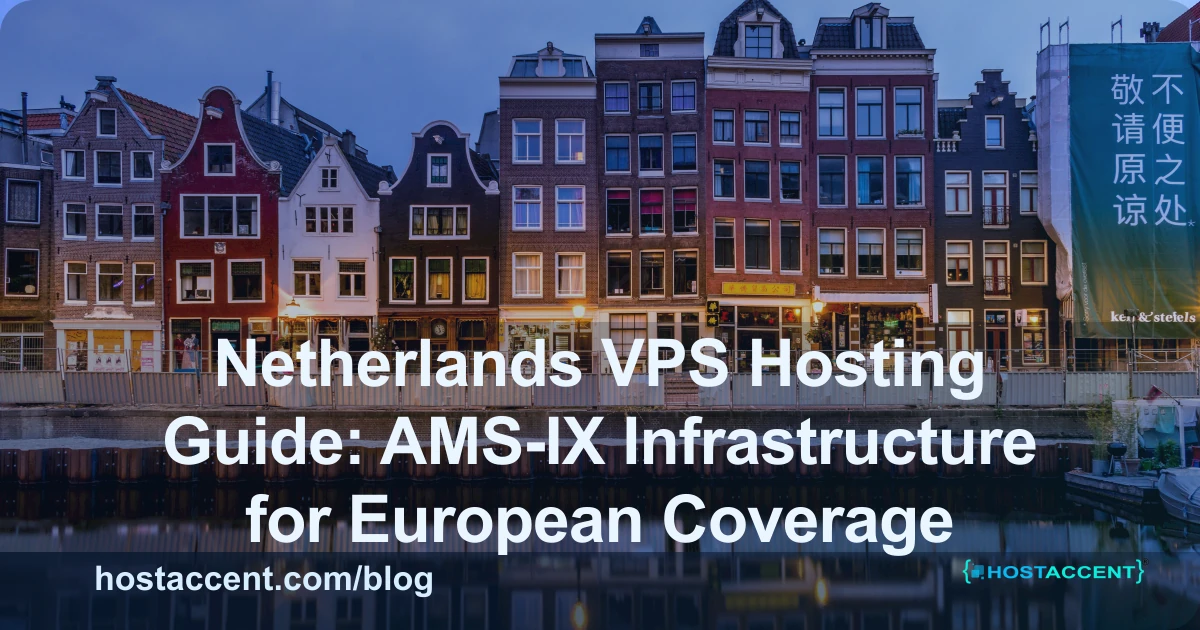
The Netherlands — specifically Amsterdam — is home to AMS-IX, one of the world's largest and most established internet exchanges. AMS-IX connects hundreds of networks through direct peering, making Amsterdam a network hub that competes directly with Frankfurt for the title of Europe's most connected datacenter location. So if you plan to buy Netherlands VPS capacity, that Amsterdam connectivity is the headline advantage.
For businesses needing European coverage with strong connectivity to Western European users, Netherlands VPS is a compelling alternative to Frankfurt — and in some cases, the better choice.
AMS-IX and Amsterdam's network position
AMS-IX handles multiple terabits per second of traffic and connects ISPs, content providers, and enterprises from across Europe and beyond. Amsterdam also hosts the AMS Internet Exchange, a second major exchange, and is home to major CDN provider PoPs (Cloudflare, Fastly, Akamai all have significant Amsterdam presence).
Round-trip times from Amsterdam:
- Germany (Frankfurt): 5–12ms
- UK (London): 8–15ms
- France (Paris): 10–20ms
- Belgium: 5–10ms
- Scandinavia (Stockholm): 20–35ms
- Eastern EU (Warsaw, Prague): 20–35ms
The difference between Amsterdam and Frankfurt for most European destinations is under 10ms — imperceptible to users. The choice between them is often more about provider availability, pricing, and specific business considerations than raw latency.
Netherlands vs Frankfurt: when to choose which
Choose Frankfurt if:
- German market is your primary target (better direct peering with German ISPs at DE-CIX)
- You need GDPR compliance under German data protection authorities (DSK)
- Your software vendor certifications specify RHEL/Germany
Choose Netherlands if:
- Your provider has better Netherlands infrastructure or pricing
- UK + Netherlands coverage is important (Amsterdam reaches London well and adds Benelux native peering)
- You prefer Dutch/Benelux data residency for GDPR purposes
- Scandinavia is an important secondary market (Amsterdam routes north well)
For most EU-distributed businesses, the choice between Frankfurt and Amsterdam is a secondary decision — either serves Western and Central Europe well.
Dutch market and Benelux context
Netherlands ecommerce. The Netherlands has one of the highest ecommerce penetration rates in the EU. Dutch consumers are price-conscious, research-oriented, and expect fast, reliable checkout experiences. iDEAL is the dominant Dutch payment method — a bank-to-bank payment system used for the majority of Dutch online transactions. Mollie and Adyen (both Dutch companies) are leading payment processors with Amsterdam-region API endpoints.
Belgium and Luxembourg. Benelux businesses share regulatory frameworks (GDPR implemented under local DPAs) and benefit from Amsterdam-based hosting proximity. Belgian users reach Amsterdam in under 10ms.
Scandinavian secondary market. Stockholm, Oslo, and Copenhagen reach Amsterdam in 20–35ms — better than Frankfurt for pure Nordic users, and significantly better than UK or US alternatives.
GDPR and Dutch data protection
The Netherlands implements GDPR through the Dutch Data Protection Authority (Autoriteit Persoonsgegevens, AP). Dutch hosting keeps EU personal data on EU soil and under Dutch/EU legal jurisdiction.
Dutch hosting providers typically offer:
- Data processing agreements compliant with GDPR Article 28
- Physical data residency guarantees in Netherlands datacenters
- SOC 2 and ISO 27001 certifications (common for Amsterdam datacenter facilities)
Production setup for Netherlands VPS
Performance:
- Nginx gzip compression for text content
- Browser cache headers (30-day expiry for static assets)
- PHP-FPM pool sized to available RAM
- iDEAL integration: if serving Dutch ecommerce, test iDEAL payment flow specifically — iDEAL redirects can be latency-sensitive
Security:
- SSH key-based auth, root login disabled
- UFW firewall: SSH, 80, 443 only
- fail2ban for automated attack mitigation
- SSL with HSTS (after thorough testing)
Dutch-specific application settings:
- Locale: nl_NL for Dutch formatting (day-month-year dates, comma as decimal separator)
- Currency: EUR with correct Dutch formatting
- Time zone:
Europe/Amsterdam(handles CEST daylight saving)
Capacity planning
| Stage | vCPU | RAM | Storage | |-------|------|-----|---------| | Benelux launch | 2 | 4 GB | 60 GB NVMe | | EU ecommerce/SaaS | 4 | 8 GB | 100 GB NVMe | | Multi-country platform | 8 | 16 GB | 200 GB NVMe |
Dutch peak retail periods: Sinterklaas (early December) and Christmas are the largest Dutch ecommerce events. Black Friday adoption in the Netherlands has grown significantly. Plan capacity 3–4 weeks before these periods.
Netherlands + CDN for full EU coverage
Amsterdam with a CDN in front is a strong architecture for EU-wide distribution:
- Amsterdam origin for dynamic requests
- Cloudflare or Bunny.net CDN edges in Amsterdam, Frankfurt, London, Paris, Warsaw for static assets
This gives Dutch and Benelux users optimal performance from the origin, while CDN edges handle static delivery for the broader EU efficiently.
Final recommendation
Netherlands VPS is an excellent EU hosting choice, particularly for businesses where Benelux is a primary market, UK+EU coverage matters, or Scandinavian users are significant. AMS-IX connectivity gives it comparable EU coverage to Frankfurt with different strengths in the northern European network topology.
The Netherlands vs Frankfurt decision often comes down to provider quality and pricing at equivalent specs. Choose the provider with better support, upgrade paths, and reliability — the network difference between the two is negligible for most applications.
AMS-IX — The World's Largest Internet Exchange
AMS-IX (Amsterdam Internet Exchange) consistently ranks as the world's highest-traffic internet exchange. Peak traffic regularly exceeds 14 Tbps, with 900+ connected networks from 70+ countries.
AMS-IX operates across Amsterdam datacenters:
- AMS1 — Equinix AM1 and AM2 (Sloterdijk area)
- AMS3 — Interxion/Digital Realty AMS campus (Science Park)
DE-CIX Frankfurt is the second-largest exchange by peak traffic volume, but AMS-IX leads in total connected network count. This breadth means Amsterdam-hosted servers reach more networks through direct peering — fewer hops, lower latency, less reliance on transit.
AMS-IX also operates nodes in other cities (Hong Kong, Mumbai, Chicago, New York) — demonstrating Amsterdam's role as a global peering anchor. The Amsterdam nodes remain the traffic core.
Why this matters for VPS: A provider peering at AMS-IX reaches major European ISPs, content networks, and CDN nodes without paying transit costs or adding latency through intermediary networks.
Latency from Amsterdam — Real Benchmark Data
Amsterdam's central EU position gives it the most balanced latency profile across all European regions.
| Destination | Round-trip (ms) | |-------------|----------------| | London | 8–15ms | | Brussels | 6–12ms | | Paris | 12–18ms | | Frankfurt | 10–18ms | | Copenhagen | 18–28ms | | Stockholm | 22–32ms | | Warsaw | 24–36ms | | Vienna | 22–32ms | | New York | 78–92ms | | Singapore | 155–175ms |
Amsterdam is the lowest-latency single point for reaching both Western and Eastern Europe simultaneously. London is marginally faster for UK-only traffic (8–12ms vs London self). For any workload where EU coverage is the priority over UK-specific optimization, Amsterdam wins on aggregate latency.
Autoriteit Persoonsgegevens and GDPR Enforcement
The Dutch data protection authority, AP (Autoriteit Persoonsgegevens), enforces GDPR with a reputation for thoroughness at all organization sizes — unlike some EU regulators who focus exclusively on large tech companies.
Key compliance facts for Amsterdam-hosted applications:
- Dutch hosting satisfies GDPR data residency within EU jurisdiction — no adequacy decision or Standard Contractual Clauses needed for EU-internal data flows
- The Netherlands has an adequacy arrangement under the EU-US Data Privacy Framework (DPF) — relevant for businesses with US and EU data flows requiring cross-Atlantic transfer legitimacy
- Dutch providers commonly hold ISO 27001 certification as a baseline — verify before signing enterprise contracts; absence is a red flag
- For companies under NIS2 (EU Network and Information Security Directive): Dutch hosting within an NIS2-compliant provider supports your organization's own NIS2 obligations
The AP has fined organizations ranging from startups to multinationals — do not assume small size exempts you from enforcement.
Dutch ISP Ecosystem and Connectivity
Major Dutch ISPs:
- KPN (AS1136) — dominant fixed-line and mobile carrier; operates one of Europe's most extensive national backbones
- Vodafone Netherlands (AS33915) — second-largest mobile operator
- Ziggo/Liberty Global (AS9143) — largest cable TV and broadband provider; strong residential market share
- T-Mobile Netherlands — growing mobile and home broadband footprint
Submarine cable connections from the Netherlands:
- AEConnect-1 — Amsterdam to New York (lowest-latency transatlantic route for Dutch traffic)
- FLAG Atlantic — Amsterdam to US East Coast
- SeaMeWe-3 — Amsterdam to Asia via the Southern route (through the Suez Canal and Indian Ocean)
- North Sea fiber corridors to the UK
This cable density makes Amsterdam a genuine hub — not just a European peering point, but a global one.
"Silicon Canals": Amsterdam's startup ecosystem is Europe's most densely packed per capita, with over 4,800 tech startups. The city is the European HQ for companies including Booking.com, Adyen, TomTom, and Uber EMEA — the ecosystem familiarity with technical infrastructure makes Amsterdam VPS a comfortable choice for EU tech companies.
See HostAccent Netherlands VPS plans — reliable Netherlands-region infrastructure with NVMe storage and 24/7 support. HostAccent Cloud Hosting — scalable cloud infrastructure for growing businesses.





Discussion
Have a question or tip about this topic? Share it below — your comment will appear after review.